Showing posts with label 1990. Show all posts

Friday, February 27, 2026

Battlemaster


A day in the life...

Battlemaster was released in 1990 by PSS, but it isn't something I recall playing. Which is a little odd because I remember seeing the screenshots and being captivated by what I saw. They showcased an overhead-action RPG featuring battles against insidious creatures, including Orcs, Spiders, Elves, giant insects, and more. These are the types of games that really appeal to me, so I'm baffled why I let it slip by. What a weirdo!

Booting it up for the first time presents an impressive title that sets the scene for what appears to be a festival of bloody gore. We can be any of 16 adventurers from four races: human, elf, dwarf, and orc. Some venture solo, whereas others are part of a clan. Beginning my first game was fun, with good graphics and a user interface I found intuitive and easy to grasp. Selecting the warrior seemed a great choice, but I made the foolish decision to touch the water, which is oddly deadly - instant death (and you only get one life).

So I restarted as an Orc; an utterly disastrous move, as I was hated by everyone, so I died quickly. Once again, I restarted, this time as an elf, which was confusing because this fella wasn't alone - his party ran around like maniacs. Then my elf fell into a pit that suddenly appeared without a warning. Instant death!

This wasn't going well. So, I did what no guy does: I read the manual. This pamphlet is short, but engaging, with a background story that is both predictable and intriguing. The gameplay basics are nicely explained, including a guide for newcomers, which I appreciated. Also explained are the differences in gameplay styles that concern commanding troops (if applicable) and negotiating with NPCs for items or safe passage.

Incidentally, I chuckled at a section of the manual about the four different races. It's humorously candid and helps you decide who you want to be. I cannot read this blunt piece of text without smiling...

Dwarves hate Elves and Orcs,
Elves hate Dwarves and Orcs,
Humans like no one but despise Orcs the most.
Orcs hate everyone!

I guess it pays to read the manual? Who'd have thunk it? Let's see the first screenshot...


The user interface isn't baffling at all. In fact, it's quite superb:
1) These are our main stats.
2) Depending on the situation, 
we can access weaponry and inventory.
3) The journey icon is replaced with Parley (returns when the quest is done).
4) The next three text options are relevant for commanding troops.
5) The green area is a scanner; we're the red cross/other characters are yellow.
6) There is an info box that provides location names and helpful tips.


A Cruel World

The first thing that struck me about Battlemaster was how you're hurled straight into the action without a hint of guidance. You then notice the frantic pace at which enemies move about. It's quite chaotic as they run into view, firing off missiles before legging it. The key to surviving is teasing them out and away in smaller groups. Otherwise, you will be mobbed by a bloodthirsty pack of medieval lunatics with a death wish.

This instantly means you must practice with the controls to get anywhere. Battlemaster employs 8-way movement using the keyboard, mouse, or joystick. The mouse is terrible, and I got nowhere with my joystick, but I need a new one, so that could be why. However, I instantly took to the keyboard, which you can redefine with 8-way controls via the numeric pad. I preferred keeping it simple, using the cursor keys.

Exploration is always fun and part of what makes any RPG a fascinating experience. What's better than discovering a new place with potential for enemies, people, treasure, weapons, etc? Well, hold your horses and slow down because you won't get very far without keeping your eyes on the scanner...

  • Use it to get an idea of where the enemy is, and begin walking towards them - with a ranged weapon at the ready. If they get close, hit the spacebar to pause and flip to a melee weapon.
  • Sounds like real-time with pause? Kinda, and you should use that!!
  • Hidden traps are a big thing in Battlemaster, but there is never any indication of where they might be. It's stupid because you only get one life, so falling into a chasm that appears from nowhere is infuriating! So tread softly. Thankfully, their locations are static and easy to remember.

Let's take a break and view a lovely woodland scene where life is peaceful and quiet...


There is an option to parley, but wait, I see a bottle on the ground?
Should I take that, or will it anger the locals into a frenzy?


Riverdale

Battlemaster's world is massive and splits into dozens of sections accessed via a world map. Once you muddle through the initial confusion of the first level, which generously teaches you the joys of hidden traps and punishes you for paddling in a stream (groan), you will blast through the following early stages pretty quickly. Every area is not only visually different but also moves the story forward in its own unique way.

It’s always worth exploring properly to see who is waiting for a chat, and whether there is anything remotely helpful like armour, food, etc. Each zone is fairly compact and has a specific task you’ll need to complete before progressing (use the journey icon, which remains greyed out until the tasks are completed).

Don't expect this game to be a pushover, as most battles devolve into chaotic scuffles where you're hammering the fire button and praying for a win. But think before raising your sword, not everyone is ready to fight. Assuming you win and don't fall victim to a hidden trap, then you will enjoy making progress because each area is uniquely interesting. That said, not everything makes complete sense, like stumbling across food the locals left lying around, hoping you'd politely ignore it. Erm, no! Why would anyone do that???

Once back in the world map, you can move to another adjacent area to continue pillaging! As you can see in the next screenshot, the game shows the available places you can (currently) travel. It's like Baldur's Gate, as you cannot travel huge distances without traversing through. And I liked that a lot!

A huge number of places are waiting for you, dear adventurer. Let's pause for a screenshot...


This map displays the various locations linked via currently available stages.


Graphics & Sounds

I'm not usually bothered by flashy visual effects in an RPG, as the adventure lies in the storyline, characters, action, and exploration. But let's be honest, they're good to have, and Battlemaster's landscapes range from lush woodlands to rocky deserts, and they look impressive. However, it’s the monster sprites that I really love. They’re fantastic and very much in the style of Dungeons & Dragons, constantly providing a 16-bit feast for the eyes to highlight the ghouls encountered, and this is where Battlemaster pleases me.

Sadly, the gameplay window is only about half the size of the screen, as the user interface occupies the other half. That's understandable for a game like this (and helpful), but I'd have expected better scrolling as a trade-off. Don't get me wrong, it's good enough, but still a little bit disappointing if I'm honest.

The audio is a mixed bag. There is no title music, but PSS didn't skimp on the sound effects by using crunchy samples. I like the cries of people dying with such elaborate samples, which is hugely entertaining.

One last screenshot of me avoiding death (for once) before the gripping conclusion...


From the start, Battlemaster shows how cruel it can be. Hidden traps!


CryptO'pinion

Battlemaster certainly plunges you into the thick of the action from the very start. The manual gives a few helpful nudges and starter tips, but nothing really prepares you for the sheer brutality of the first area. Choose your character wisely based on their skills, weapon types, and whether you want backup or to go solo. Then spend a little time mastering the controls and getting used to scrapping with the enemy.

Even once you've got the basics down, you're still likely to meet a quick and ridiculous end, which is hard to initially grasp. It might be a mob of goons hiding in a cave who leave you no chance to react, or maybe it’s an arrow from off-screen, or the classic blunder of sipping water from a deadly river. Worse still, death may come because of a perfectly hidden trap that you had no way on God's green Earth to detect.

Every step you take will be like walking on eggshells, and you will suspect everyone and be wary of everything. Nothing scares me more than a bottomless pit suddenly appearing from out of thin air, but these are always located in the same place(!). Once you grasp how pointlessly illogical these initial traps are, then progress will be made to other areas. Regardless, save your game regularly, as you will be reloading a lot.

Battlemaster's emphasis is always on action and solving obscure puzzles. Discovering new lands is very exciting, as you see the story unfold with new places, tales, and people. Plus, there is a myriad of different beasts just waiting to be killed. Also, if you’ve built a good team, the squad mechanic actually works quite well - even if the AI is a bit thick. Controlling them feels a bit clunky at times, but I enjoyed giving the orders!

When I first played Battlemaster, I didn't care for it. You're thrown in at the deep end, and the pointless traps become tiresome. However, I liked the setting and the opportunity to travel to unique places, so I stuck with it. I'm glad I did. You will get to wander strange lands, slay monsters galore, and do it all in the name of a baloney storyline. It's fantastic, so I’m giving it a trapdoor-dodging, monster-mashing 85%.


I love going into other people's homes uninvited.


Hey, I see a ladder. I'm sure nobody will mind if I take that...


I found a hidden cave and went inside. This is a dangerous place!!


I only took this screenshot because I liked the graphics so much lol


This is where I'm currently up to, and stuck. How can I get through the door?

Thursday, May 08, 2025

Armada


BattleScapes

I wanted to pay my respects to the service men and women who have sacrificed to keep us safe. I'm not really into "military/war" games, so I wasn’t sure where to start. The Atari ST has a huge selection, and the closest I’d ever come to the genre was probably D-Day a few years back. But I knew I had to do something for our pride in #VEday80 - and then it hit me, like a cannonball fired from The Golden Hind! (geddit??)

Okay, I’ve got a bit of a "thing" for Atari’s ARC label. I've been slowly collecting their games over the years - I'm just waiting on a (decent) copy of Photon Storm to complete the set. Anyhow, that also means some games have been merely sitting idle on my shelf! Heck, I've never played Gettysburg, Armada, Prince, or Borodino. Well, I dabbled in Prince, but was blown away by its learning curve (I'm lazy). It was now that I realised how many "war" games I owned - maybe I’m more of a fan than I consciously realised. Ha, maybe!!

So, what to play for the big day? Well, I just flipped a (virtual) coin and took a chance...

Armada was the winner, which means I was about to set sail on the high seas around southern England for a war against the superpower, Spain. Armada was released in 1990 by Peter Turcan, the same developer behind Waterloo, Borodino, Austerlitz, and Gettysburg. Wow, I guess he really likes his history?

The game is based on historical events and is definitely one you will struggle to play without the manual. Not just for the backstory but for an understanding of how to command your fleet, as I discovered. The manual is great, providing a concise account of the historical events without becoming a long-winded chore to read through. I'm not much of a reader, but I set aside an evening to go through it. And I’m glad I did!

It’s a fascinating period in European history. I learned that the sheer numbers the Spanish managed to gather were impressive, becoming nothing less than formidable. But when you look back on these events, things did not go according to plan. It's an understatement to say the battles didn’t quite live up to their expectations - more like a soggy dud firework that failed to go off. Regardless, it’s surreal reading about these events, especially considering the limited technology, navigation, and communication of the time.

For me, that "dud firework" moment came early on. It became clear that, while the Spanish had an enormous fleet, they lacked the skill and experience of the English, who had the disadvantage of a smaller fleet. It’s hard to go into much detail without spoiling the game you will play. That said, it was heartbreaking to read how the men in the Spanish fleet ended up circling Britain, almost starving, before facing their cruel and bloody fate. And then, how the English government appallingly treated their victorious veterans afterwards.

I hope this is proving as interesting for you as it is for me. Shall we pause for some screenshots...


The game introduces the opening moments of the war.
You are asked some questions that assist in your learning of this deep game!


The graphics draw before your very eyes and look pretty nice.
The ships are well represented, as is the coastline of southern England.


Reliving the War

It's 8am, July 31st, 1588, and the Spanish Armada have been sighted off the coasts of Cornwall. It's time to gather the brave men and head out into the seas to defend England. But wait, don't sail out yet because a few questions require answering. These help to configure your experience, especially for new players:

  • Trail Fleets - Basically, lower the number of ships to make it quicker and more manageable. Choose "Y".
  • Two-Day Battle - A shorter game, so newcomers should choose "Y".
  • Human/Computer - Either can be chosen for English and/or Spanish. (Y/N)
  • Signalling - Used as a trainer, believe it or not, for new players, so answer "Y"
  • Viewpoint - Another "cheat" for new players, but something I'd consider answering "N" to.
  • Cannon firing - Of course, you must answer "Y" to see the action! (sarcasm)
  • Existing Orders - Choose whether to keep things historically accurate, but you can still override.

From the perspective of the English, we play as Admiral Lord Howard. We will take command of our squadron along with those captained by Drake, Hawkins, and Frobisher. The game begins at the battle's dawn, and depending on how you answer the human/computer question, you are either English or Spanish.

If you choose to be Spanish, you are Alonso Pérez, the Duke of Medina Sidonia (the computer could play the part of the English). Of course, you could attempt to play both sides or leave the computer to act out both sides of the conflict for you. But why you would want to do that is anyone's guess!

Now the game begins, and you are bewildered! Yep. So let's pause for a couple of screenshots...


You can request updates from particular captains or the squadron as a whole.


Use the mouse to identify places and any vessels.


A time to lead

The game begins, and you feel abandoned and left without a plan or any kind of assistance. Armada leaves you out in the cold!! So, grab the manual and also look at the underwhelming paper map inside the box. What? You have a cracked copy? Ha, play something else then - you don't stand a chance mate!!

I mean this - immediately, you are thrown in at the deep end. A visual representation of the day is drawn before your very eyes. You are instantly expected to command and give orders. If I'm honest, this is a truly bewildering moment. Quite mind-blowing, and I felt lost wondering where to begin. I'll say it again, you must read the manual. But, even then, you're left unaided with a fleet of men looking at you for leadership!

Armada is nothing like I expected. I thought I would have icons to click, but instead, we use a command-line parser much like a text adventure. Commands are structured and issued in a set format of [to whom] [when] [what to do] [timescale]. This is powerful but very difficult to understand, as I found out.

Here are the commands that I have come to use often. There are lots more commands apt at particular points in the conflict, but consider the following a list of the base commands you will probably use. There are two main types of commands: either you signal the squadrons (or ships) directly, or your own captain.

With that in mind, here are some examples...

signal all squadrons to sail to plymouth
captain sail to plymouth
These mean exactly what they say, everything heads in the direction given. The first, commands the fleet. Whereas the second, yours. You can tailor that to send Drake to Poole, for example.

signal Hawkins to sail in line astern formation
captain sail in crescent formation
You may wish to adopt a nice pattern to sail the seas? The first command directs Hawkins' squadron. Whereas the second is ours. You can also command all the squadrons.

signal drake to blockade Plymouth
This is mentioned in the manual and something to consider, but maybe not only Plymouth?

signal all squadrons to attack enemy
signal drake attack enemy
When the time is right and the enemy is closing in - fight (with lame cannon effects). The first commands everyone to attack. However, if you have left (as in the example above) Drake elsewhere, then you might direct him separately. It depends on how you direct the battle.

captain adopt short/long range tactics
signal all squadrons to adopt short/long range tactics
signal Frobisher to adopt grappling tactics
These commands are interesting. If you aren't close, then long-range tactics (cannons) are needed. Grappling is when you are close and you attempt to board an enemy ship.

signal all squadrons disengage
signal all squadrons send me your battle reports
The first command helps you to backtrack, if in trouble. The second command provides feedback provided by each squadron. It's slow and pre-internet speeds!

As you can tell, the manual is desperately needed. I personally think this game is impossible to play without it. The manual may have a fantastic backstory to the war and provides lots of technical details about the ships, and much more. But it's not great at assisting a (new) player. I felt it didn't help with the basics, so you spend the first few games blindly guessing what to do without much visual feedback to aid.

With that in mind, we definitely need a break! So here are a few images you will appreciate...


After reading all the above, you may be disappointed. Fear not, we have a mouse!


That's right, whenever the fleet requires commanding, use the mouse to identify ships/etc.


I had a play with formations, but I think I made things worse! lol


Here you can see my ships heading towards the distant Spanish fleet.


The CryptO'pinion

Beginning Armada is baffling. More than I realised, so I dug out the map and re/read parts of the manual - yet again. Learning the commands and their finicky structure was tough, very tough. So I don't think this war game will be for everyone. If you're brave enough to download it, then this is my humble advice:

Remember that you have your own Captain onboard (and your own squadron of ships). This means you don't need to worry about the finer details because you should leave the captain to worry about that. However, you still need to address your squadron as you would the others - Drake, Hawkins, and Frobisher. Get an image of how that setup looks in your mind, and rather than directing commands at ships, use squadrons.

For a quick start, I figured Plymouth or Poole were destinations worthy of a Spanish attack. So my tactic was to flood these seas with my fleet. I blocked off Plymouth using Drake's squadron and left Frobisher nearby. That left two squadrons, which I took towards Poole. Well, that was my novice theory. And I felt it worked.

Regardless, this game is huge and has a technical command-based system. So that means its learning curve is massive and probably the biggest of any ST game I've played. I fear this could put many off it. Having said that, I rather enjoyed playing Armada a bunch. I ended up beating the Spanish after a handful of games. That was quite a proud achievement, considering the negative thoughts I had on my first attempt.

Armada is only for war fans. If that's you, I would easily rate this old seadog an apt 80%.


This doesn't happen often (and it didn't happen on my first "few" attempts!).
But eventually, I did it and stopped the Spaniards from invading my country. Woohoo!

Thursday, February 20, 2025

Defender II


Defenda

Unlike many of you, my first experience with Defender wasn’t in the arcades but on my ZX Spectrum. That little machine wasn’t exactly a powerhouse, but it was versatile and capable of handling this arcade shooter. I could be wrong, but I'm sure it was Defenda by Interstella Software, released in 1984. I absolutely loved it, though I wouldn’t exactly call myself skilled. Oh, what a shocker - Steve is rubbish at a fast-paced shooter!!

Fast forward a good few years, and along comes ARC with Defender II, developed by none other than Jeff Minter. Oddly enough - and I know this is practically sacrilegious coming from an Atari ST guy - whenever I hear his name, I immediately think of the Jaguar's Tempest 2000. I spent countless hours playing that trippy game in 1994/95. And half the time, I’d just leave it running in the background!! But anyway, back on topic - Minter programmed Defender II for the ST in 1990, and it’s everything you’d hope for, with loads of extra visual flair jazzing up the arcade classic. Not only that, but the two original games are included as well.

Yes, Defender and Stargate are included, but my focus is on Defender II. Don’t get me wrong, having all three games in one is incredible, but if I’m being brutally honest, they’re pretty similar. That statement might get me slapped by a purist, but hey, whatever. At the end of the day, I fire it up to play Defender II.

Let's have a break for some screenshots that really don't do the action any justice...


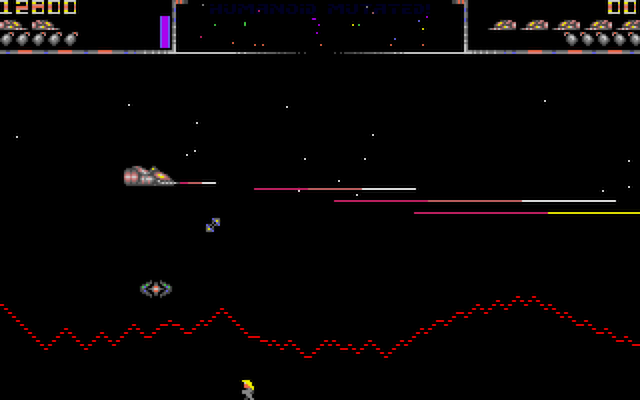
As a base comparison, this is the original Defender. It's zany, zappy, and FUN!


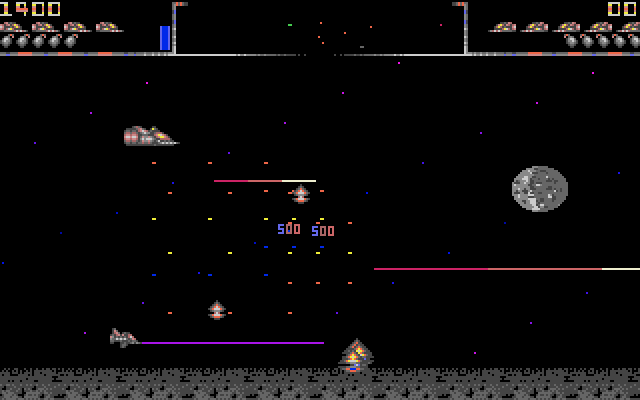
Defender II explodes all that zappy'ness into a zillion Llama-crushing pieces.


Defender II

From the golden era of Space Invaders, Asteroids, and Pac-Man came a furious shooter called Defender. The objective is always the same: little men wander the planet’s surface, innocently going about their business - until aliens swoop in from the skies, intent on abducting them for some bizarre, probe-related experimentation. We can’t let that happen! So, we skim the planet’s surface, blasting every last alien into smithereens. It’s a wonderfully simple concept, like so many old games. Straight to the action, and I love that.

The controls weren’t quite what I expected. Defender II uses a combination of mouse and keyboard. Moving the mouse adjusts altitude, the left button thrusts, and the right changes direction. So how do you shoot? That’s done with the Shift key, which you can hold down for rapid firing. And because this is Defender, I naturally want a smart bomb to clear the screen when things get tough - just hit Control, and hey presto, BOOM!!

But there’s more gun love just waiting to be discovered - pressing Alt unleashes an electrical weapon called the Smart Laser, which instantly fries anything nearby. It’s powerful but has limited fuel reserves, so I tend to use it early on when the screen is flooded with (far too many) enemies for my meagre reflexes. Thankfully, every 10,000 points earns you a fuel top-up, along with an extra life and another smart bomb.

Jeff Minter didn't hold back and cranked up the mayhem, making Defender II an even more exhilarating arcade experience. And it doesn’t stop there - we have an optional AI Drone, a handy companion that mirrors your actions for much-needed extra firepower. Hitting the Spacebar toggles its functions between this standard mode and a powerful "toothpaste" laser (stronger beam), up-shooter, and bombing mode.

Defender II goes beyond anything I expected from a mere Defender clone. Jeff has transformed it into something else entirely. The AI Drone is a brilliant addition, but for me, the true game-changer is the Smart Laser. With that, your experience - and progress - improves more than you ever thought possible!

It's about now that you should leave to boot up your Atari ST to play. Wait, don't go just yet...


The training mode is superb as it introduces you to everything very nicely.


Completing a wave results in this nifty info screen with bonus rewards.


Aesthetics

It’s hard to imagine a game from the early 80s could be dramatically improved. After all, it’s Defender - a game where a black background takes up 95% of the screen. Well... hold my beer... because ARC’s version is an absolute visual feast, far beyond anything the original ever was. The credit for these sexy pixels goes to Wayne Smithson and Simon Butler, though, at first glance, they might not look like much.

What I mean is that the magic happens only when triggered by playing the game - firing and obliterating enemies. These actions turn boring old Defender into a psychedelic explosion of party pixels. It’s pure visual chaos - stunning and borderline hypnotic. At first, I found myself watching the dazzling display rather than playing - so I kept dying! When playing properly, the action never lets up, throwing an eye-popping, high-energy spectacle at you from start to finish. Honestly, it’s one of the best-looking games I’ve seen.

The audio is almost as impressive, packed with superb sound effects that belch and burp loudly with every move you make. The laser - easily the most frequently heard sound - has more of a machine-gun vibe, though it takes a backseat whenever explosions and other effects are heard. It’s a shame the DMA hardware wasn’t utilised, but honestly, I have no complaints - Defender II is as loud and obnoxious as it is visually glamorous.

Interestingly, the theme music was created by Martin Walker using Microdeal's Quartet. I love what musicians have managed to produce with that, and I only wish it had been used more often. Superb music.

Right then, I'm yapped on enough, so carry on scrolling for the ultimate opinion you're dying to read...


Having 3-in-1 is tremendous Minter value. Play the originals - they're damn excellent!


Of course, it's Defender II I prefer - there's nothing quite like it!


The CryptO'pinion

Disregarding the fantastic value of three games in one, this is an absolutely stupendous product. Defender II is a monumental shooter - a true masterpiece, perhaps even superior to StarRay or Anarchy?

It’s not just the frantic speed or the jazzy visuals that make this version so brilliant; it’s the innovative new weaponry that transforms the basic gameplay without ruining it. The drone is a worthy addition, offering several attack modes (though, in my humble opinion, it’s best left as it is). It’s the smart laser that really tips the balance, elevating the game from being great to truly exceptional. This underrated feature is a must-use, as it compensates for slower reactions and lets you progress deeper into the later missions.

I’m sure you’ve all guessed it by now: I’m giving it a massive 98% and awarding it the AtariCrypt SMASH accolade. Defender II is arguably the best horizontally scrolling shooter for the Atari ST. Wow, that's a bold statement, alright! So let me know what you guys think in the comments section below.

Right, waste no more time and click these links to play Defender II...

Level 5 - FLOYD
Level 9 - FURRY
Level 13 - BEAST
Level 17 - LEMAC
Level 21 - ZIPPO
Level 25 - LASER
Level 29 - DAFAD
Level 33 - MAGOG
Level 37 - FUNKY
Level 41 - DONKY
Level 49 - KANJI
Level 53 - IRATA
Level 57 - NEURO
Level 61 - STOAT


Any easy SMASH rating, so go and grab it off those download links!!

Monday, January 13, 2025

Clown-O-Mania


Clowns make everyone laugh, right?

Clown-O-Mania sounds like the perfect title for today's crazy world. Instead, it's an Atari ST game developed by Matthias Krenzel and Carsten Mohr and released in 1990 by Starbyte. However, it's not a game I remember; my first impressions are of Spindizzy Worlds or Crystal Castles, which is not a bad thing.

So what's the story? Well, Beppo the Clown was strolling through the circus and found a mysterious map. Not just any map, but a mysterious map! This tells of a hidden place with valuable crystals. Beppo cannot ignore the temptation and quits the circusOddly, he remains in his clown gear and makeup! Anyhow, he finds the location and wants the crystals. Can we help him get rich? It's doubtful with me in charge of the joystick!

Let's look at the opening level, which is a great way to learn the basics...


Many levels are designed with multiple layers accessible via ladders and more.
I've collected a few crystals, but what are those two green "things"?
Can you see those blue boxes? They look helpful.


Let's play

All levels are displayed as an isometric map using different square tiles. Each is a mini-labyrinth made of sections, so teleporters, ladders, and more are used to get around. The objective is dead simple - collect every crystal. Earlier maps are easy, and they help to gradually introduce different elements and enemies as you progress. That's about as complex as this game gets. Collect the pills like Pac-Man and move on to the next.

Of course, it's not always so straightforward, as later levels are large and littered with pitfalls and enemies. Thankfully, there are collectables to aid your quest, like "jumps" and "razors". Jumps are a teleport and great when things get too difficult. Razors can be used as projectile weapons to kill the nasties.

The tiles of each maze offer various benefits alongside some strange effects. Arrowed tiles allow you to move only in a particular direction. Coloured tiles provide bonuses when they're all the same. Blue tiles reminded me of Wipeout to provide extra speed. Jump tiles leap you into high places (rewards for landing on a baddie!). However, the most infuriating are the yellow-patterned tiles that twist the world on its head!

Additionally, funnels and transporters provide instantaneous access to other areas. Those are blue with a yellow dot and reminded me of a litter tray lol. Use the pyramids to block the path of roaming baddies - think along the lines of Highway Encounter. However, you should increase your energy levels to utilise them fully. Fortunately, clown masks are scattered throughout the levels, offering a much-needed extra life.

Movement is slick and responsive using the joystick, of course. Pushing up moves you diagonally up/right, whereas pulling down moves you down/left. It sounds awkward, but I grew up with isometric games from 1984 (thank you, Knight Lore), so I'm used to this concept. It's easy to learn and perfectly apt.

What, you think this is an overcomplicated isometric Pac-Man? Let's break with some screenshots...


One of the first collectables is a severed bald head. Or a 1-UP ;o)


Watch out, those yellow tiles will flip everything on its head!


Aesthetics

Visually, this game is both fantastic and disappointing. What, I hear you cry! Am I insane? Well, yes, but hear me out... The pixel art is (I think) by Orlando Petermann and Roman Bossart, and they did a wonderful job. Beppo's details are superb, albeit with a surreal Rolling Ronny vibe. I also love the baddies (great AI) and each level, whilst lacking the glam of other isometric games, looks clean and concise.

Sadly (here we go), the poor old AtariST might look good, but the programming behind the scenes fails by comparison. It feels like a weak Amiga port because there is no scrolling. That makes later levels far too difficult, as you cannot see what enemies are nearby. Not until it's too late (think Cannon Fodder).

The audio fares much better with a belting chiptune by Adrian Dalecki. It's subtle and suits the gameplay without overpowering your concentration. Sadly, this is the only tune constantly playing alongside the sound effects. There's nothing wrong per se, as the music (and effects) are good, but more tunes were needed.

It's not looking that great, isn't it? Well, let's take another pause for some screenshots...


Why not change the colour of those tiles like in Jumping Jack'son.


Level 9 appears far more complex than it is. Hey, if I can do it...


The CryptO'pinion

It's tough to give an opinion when I didn't get anywhere near completing this game. After about a quarter of the way through, I hit a brick wall as the lack of scrolling made it impossible for me to continue. I'm genuinely gutted because I was having a blast until then. The levels are great and require much concentration to figure out a safe route, whilst worrying about other elements such as traps and the map's many enemies.

This game had great potential, but ultimately, it didn't fully deliver. It's obvious why. I'm disappointed Starbyte rushed this game through without utilising the ST's capabilities. My rating is a disappointing 55%.

I hate lame ports, but I'm always interested in your thoughts. Let me know in the comments.

+ Floppy disks can be found over on Atari Legend: https://www.atarilegend.com/games/clown-o-mania
+ 8BitChip has the hard drive version: https://atari.8bitchip.info/SCRSH/clownom.html


Hey, I wonder what will happen if I jump inside that funnel?


I loved this level, those arrows aren't nearly as bad as they look!


I should really take the screenshot before collecting the pills. Looks a bit dull ;-)


Do you want a tip for later levels? Always collect the razors (blue/red lines)


Level 19 is insane and gave me isometric Dungeon Master vibes because of the baddies!
(That green tree thingy reminds me of a Screamer)